Early Life and Immigration Struggles
I often think about how life can pivot on a single decision, like a tennis ball teetering on the net before dropping to one side. For Alex Kenin, that pivotal moment came in 1987. Born around 1970 in the bustling, iron-curtained city of Moscow, Soviet Union, Alex grew up in an era where opportunities felt as scarce as open tennis courts in winter. He was no stranger to grit; recreational sports like basketball and soccer filled his youth, but tennis? That was a distant dream in a place where rackets were luxuries.
At just 17 or so, Alex made the bold leap to the United States, chasing what he called the “American Dream.” He arrived in New York City with his young wife, Svetlana, clutching barely $286 in their pockets. Imagine that: two immigrants stepping onto unfamiliar soil, armed only with hope and a few crumpled bills. The early days were relentless. Alex juggled night shifts as a taxi driver, navigating the chaotic streets of New York, while dedicating his days to studying computer programming and English. Language barriers loomed like insurmountable walls, but he chipped away at them, one class at a time. Survival wasn’t optional; it was the daily grind that shaped him into the resilient figure he became.
Svetlana, often called Lena, stood by his side through it all. A former nurse from Russia, she brought a steady hand to their fledgling family life. Her background in healthcare provided a quiet anchor amid the storms of adaptation. Together, they embodied that classic immigrant tale, turning scarcity into stepping stones.
Building a Family in America
By the mid-1990s, the Kenins had planted roots deeper in American soil. They briefly returned to Moscow in 1998 for the birth of their first daughter, Sofia, leveraging family support back home. Sofia Anna Kenin entered the world on November 14, 1998, a tiny bundle who would one day wield a racket like a warrior’s sword. The family lingered in Russia for a few months, where Sofia’s grandmother helped with childcare, before resettling in the U.S.
They eventually moved to Pembroke Pines, Florida, seeking warmer climates and better prospects. Here, their family grew with the addition of a younger daughter, Anya. Details on Anya remain sparse, like shadows in the background of a family portrait, but she’s part of the tight-knit unit that defines the Kenins. The family identifies as Jewish, with Sofia proudly declaring herself “100% American,” a sentiment that echoes Alex’s own transformation from Soviet emigre to U.S. patriot.
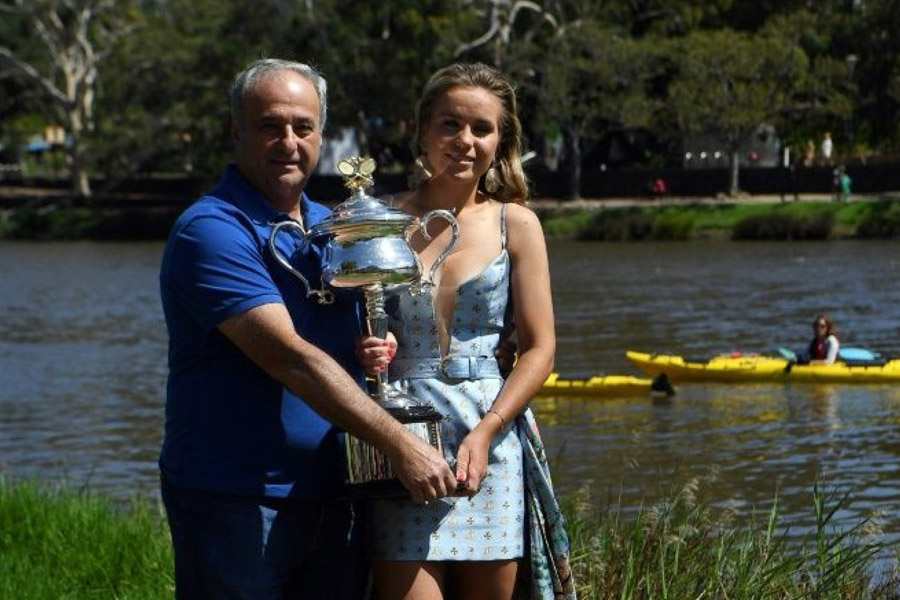
Alex’s bond with Sofia stands out as particularly profound. From her earliest days, he introduced her to tennis in their driveway, using oversized rackets that dwarfed her small frame. By age three or four, she was smacking balls with a focus that belied her years. He recalls how, at 10 or 11, she could already outplay him, a humbling yet joyful milestone. Their relationship mixes affection with intensity, like a well-tuned engine humming under pressure. Public moments, such as a tender kiss before her 2020 Australian Open semifinal, reveal the softer side beneath his burly exterior.
Svetlana’s role can’t be understated. As a nurse, she provided financial stability in those lean years, allowing Alex to pursue his evolving passions. The family dynamic feels like a well-oiled machine, each member contributing to the whole. Yet, it’s not without its tensions, especially as Sofia’s career thrust them into the spotlight.
Career Shift: From Taxi Driver to Tennis Coach
Alex’s career suggests reinvention. He worked nights driving cabs and car services in the late 1980s and 1990s, coding and conjugating. He switched to coaching in Sofia’s early teens as her talent grew. Without formal education? No issue. Alex studied by watching experts and studying ancient literature like a scholar.
Sofia trained under Rick Macci in Florida from 2003 to 2010, but Alex was her tutor. He drove long distances for practices and tournaments with a basket of balls. Sofia became a “crazy smart” competitor with his self-taught mental toughness and cunning techniques.
This work paid off in the 2010s. Sofia became junior world No. 2, won the 2014 Orange Bowl, and reached the 2015 US Open junior final. Alex coached her to three WTA titles in 2019. Sofia’s 2020 Australian Open win against Garbine Muguruza and French Open final performance versus Iga Swiatek were the peak. Alex’s insightful tutoring helped her win WTA Player of the Year that year.
Family finances rise from poverty to success. Sofia’s $11.6 million lifetime earnings greatly exceed their $300 start. Alex has no independent wealth, yet her achievement benefits the family. After a temporary coaching break in May 2021 due to performance declines, they rejoined in November and won doubles titles with Bethanie Mattek-Sands, including the 2024 Miami Open.
Recent Challenges and Public Scrutiny
The 2020s have brought highs and hurdles. In 2025, during Sofia’s Abu Dhabi Open loss to Anastasia Pavlyuchenkova, Alex’s rude hand gesture caught on camera ignited online backlash. It was a moment of raw frustration, like a storm cloud bursting over a clear day. Then, in January 2026, at the Brisbane International, he hurled a water bottle after Sofia’s double fault in a 7-6(2), 6-3 defeat to Ekaterina Alexandrova. Fans erupted, calling for a permanent split, arguing his intensity might hinder her resurgence.
Social media buzzes with debates. On platforms like Reddit and X, users label him “gruff” or “overbearing,” comparing him to other parent-coaches. Yet, Sofia, now 27, persists with him, reaching the 2025 Charleston final but bowing out early at the 2026 Australian Open (6-3, 6-2 to Peyton Stearns). These incidents paint Alex as a passionate protector, his actions amplified under the microscope of fame.
Timeline of Key Milestones
To map out Alex’s journey, I’ve compiled this table of pivotal events. It captures the ebb and flow of his life, from humble beginnings to tennis triumphs.
| Year/Period | Event |
|---|---|
| ~1970 | Born in Moscow, Soviet Union. |
| 1987 | Immigrates to New York with Svetlana; starts with ~$300. |
| 1987-1998 | Taxi driver at night; studies computers and English by day. |
| 1998 | Sofia born in Moscow; family returns to U.S. soon after. |
| Early 2000s | Settles in Pembroke Pines, Florida; introduces Sofia to tennis at age 3-4. |
| 2003-2010 | Oversees Sofia’s training with Rick Macci. |
| 2010s | Guides Sofia to junior successes, including 2014 Orange Bowl win. |
| 2019 | Sofia wins three WTA titles. |
| 2020 | Coaches Sofia to Australian Open win and French Open final. |
| May 2021 | Sofia splits from him as coach. |
| November 2021 | Reunites for 2022 season. |
| 2024 | Sofia claims doubles title at Miami Open. |
| 2025 | Rude gesture at Abu Dhabi Open sparks criticism. |
| January 2026 | Water bottle incident at Brisbane; early Australian Open exit for Sofia. |
This chronology underscores his enduring influence, a thread weaving through decades.
Personal Traits and Family Legacy
Alex strikes me as a blend of toughness and tenderness. Described as burly with a twinkling eye, he’s funny and resilient, fleeing Russia for his children’s future. His coaching philosophy, born from observation, mirrors his life: adapt, strategize, endure. The family’s Jewish heritage adds cultural depth, though Sofia’s American identity dominates.
Anya, the younger sister, remains enigmatic. Little public info exists, but she completes the quartet, perhaps enjoying a quieter life away from the courts. Svetlana’s nursing past suggests a nurturing core, balancing Alex’s drive.
In reflecting on the Kenins, I see a mosaic of sacrifice and success. Alex’s story reminds me that greatness often sprouts from unlikely soil, nurtured by unwavering family bonds.
FAQ
Who is Alex Kenin’s wife?
Svetlana Kenin, affectionately known as Lena, is Alex’s wife. A former nurse from Russia, she immigrated with him in 1987 and provided crucial support during their early struggles in the U.S. Her steady presence helped stabilize the family as they built a new life.
What are the names and ages of Alex Kenin’s children?
Alex has two daughters: Sofia, born on November 14, 1998, making her 27 years old as of 2026, and younger sister Anya. Sofia is the well-known tennis professional, while Anya keeps a lower profile with limited public details available.
When did Alex Kenin start coaching Sofia?
Alex began informally coaching Sofia around age three or four in the early 2000s, using their Florida driveway for practice. He became her primary coach by her early teens, learning techniques through dedication despite lacking formal training.
What controversies has Alex Kenin faced recently?
In 2025, Alex made a rude hand gesture during Sofia’s Abu Dhabi Open match, drawing online criticism. In January 2026, he threw a water bottle in frustration at the Brisbane International, fueling fan demands for Sofia to seek a new coach amid concerns over his influence on her performance.
How much has Sofia Kenin earned in her career?
Sofia’s career prize money surpasses $11.6 million, a significant achievement that reflects the family’s rise from modest beginnings. This financial success stems from her 2020 Grand Slam win and other titles, indirectly benefiting Alex through his coaching role.