A Life Rooted in Art and Motion
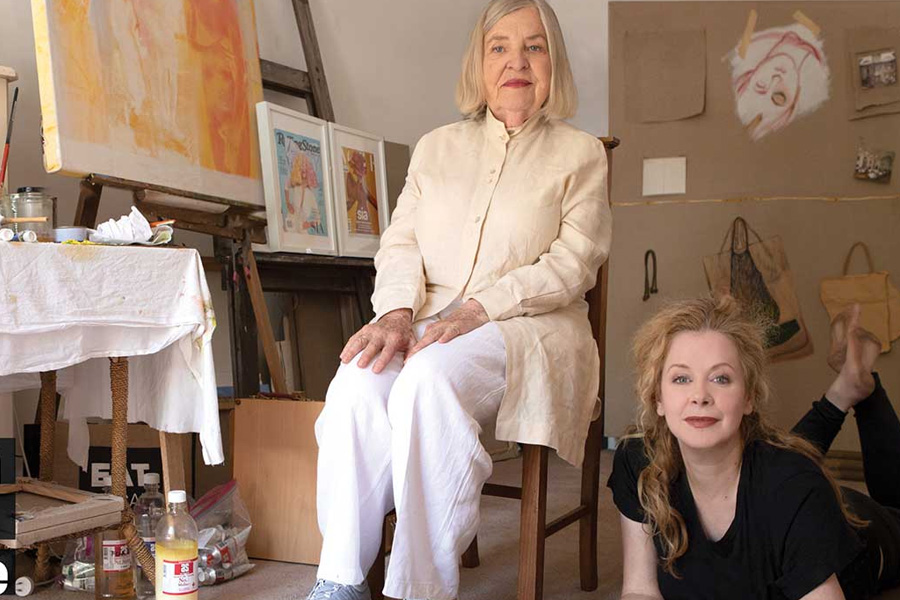
I see Loene Furler as the kind of person who does not fit neatly into one frame. Born in 1944, she grew into an Australian artist whose life has moved across painting, printmaking, photography, film, music, textiles, teaching, and arts leadership. That breadth matters. It tells me she did not treat art like a single room with one locked door. She treated it like a house with many windows open to the weather.
She studied at the South Australian School of Art and completed that phase of training in 1965. By 1966, she was teaching in Adelaide. Soon after, she moved to London in late 1966, a move that placed her in a wider artistic current. In 1967, she married painter Vytas Serelis there. The early arc of her life already feels restless in the best sense, as if she were collecting textures, places, and voices for work that would come later.
By the early 1970s, she had returned to Adelaide and taken up further study in sculpture and ceramics. That shift matters to me because it shows a maker willing to keep changing shape. Some artists harden into a single style. Loene seems to have stayed porous, like wet clay still ready for the hand.
The Family Circle Around Loene Furler
The family story attached to Loene Furler is compact, but each person in it has weight.
Vytas Serelis was her husband in 1967. He was also an artist, and the pairing makes sense to me. Two artists in one household can be a bright storm, full of friction and energy. Their marriage belonged to a period when Loene was still finding the direction of her mature practice. By the early 1970s, that marriage had ended. Even so, Serelis remains an important part of her story because he stands at a crucial turning point in her personal and creative life.
Phil Colson was Loene’s partner and the father of her daughter, Sia. He appears in the story not as a distant footnote but as a musician in his own right, someone who taught Loene to play bass guitar. That detail is beautiful to me. It suggests a relationship built not only on romance or parenthood, but also on shared sound, rhythm, and learning. He was part of an Adelaide music scene in the early 1970s, and that musical atmosphere seems to have seeped into the household like light through a thin curtain.
Sia Kate Isobelle Furler, known simply as Sia, is Loene’s daughter and the most widely recognized member of the family. Born in 1975, she became a globally known singer and songwriter. In the family portrait, she is not a separate painting hung in a different gallery. She is part of the same wall. Loene’s own artistic life and Sia’s later career feel connected by inheritance, atmosphere, and example. The mother did not only give birth to a child. She helped shape a creative climate.
I did not find evidence of other family members being publicly documented in the material I reviewed, so this small circle remains the clearest one. Small does not mean slight. It means focused, like a beam of light drawn to a few strong points.
Career Work That Refused to Stay Still
Motion and expansion define Loene Furler’s career. After returning to Adelaide, she studied sculpture and ceramics in the early 1970s. She taught printing at Indulkana and Ernabella in the Pitjanjatjara Lands from 1982 to 1987. That was one of her most crucial professional periods. Teaching in distant areas is hard work and responsibility, not a resume line. It requires patience, respect, and pre-speaking listening.
Her art changed with her instruction. I understand how textiles and fabric work evolved from those years. A teacher who works with location absorbs her surroundings. The lexicon includes color, surface, pattern, and memory. Loene’s art incorporates self-portraiture, travel, memory, hidden forms, and organic images. These ideas feel like buried roots. They keep the tree upright but are rarely seen.
She advised the Minister of Arts, Local Government, and State Services in 1989. Another aspect of her existence is revealed. Not only did she make and teach art. She influenced institutions and policy. She was JamFactory CEO from 1994 to 1996 and led the Experimental Art Foundation, NAVA, and Craft Australia. She was not on the cultural edge. She helped create fences, walkways, and bridges.
Music, Motherhood, and a Wider Creative Life
Music weaves through Loene Furler’s story, which is stunning. The same guy who studied art, taught printmaking, and led cultural groups played bass in a band for ten years. She mentioned learning bass about 40. That detail energizes her biography. It argues reinvention was gradual. It was routine.
Her life with Phil Colson and Sia is interesting because music is part of the family’s daily routine. A woman learning bass from her boyfriend and watching her daughter become a major vocalist years later is a story that resonates. Domestic life is more like a chorus than a line. Though diverse, all voices are linked.
Loene mentored and taught. That important since influence is a clear life indicator. People make things. Pathmakers exist. Looks like Loene did both. Honors for decades of contribution have been given to her works in public collections. She participated in more than Australian art. She supported it.
A Timeline in Dates
| Year | Moment |
|---|---|
| 1944 | Born in Australia |
| 1965 | Completed studies at the South Australian School of Art |
| 1966 | Taught in Adelaide and moved to London |
| 1967 | Married Vytas Serelis |
| Early 1970s | Returned to Adelaide and studied sculpture and ceramics |
| 1975 | Sia Furler was born |
| 1982 to 1987 | Taught printmaking in the Pitjanjatjara Lands |
| 1989 | Became adviser to the Minister for the Arts |
| 1994 to 1996 | Served as CEO of JamFactory |
| 2002 | Major survey exhibition of her work |
| 2016 | Appeared at the opening of the Sia Furler Institute |
| 2022 | Honored for lifetime contribution |
| 2023 | Served as an art prize judge |
| 2024 to 2025 | Continued to appear in media, exhibitions, and arts conversations |
FAQ
Who is Loene Furler?
Loene Furler is an Australian artist, educator, arts leader, and mother of singer Sia. Her life spans visual art, music, teaching, and cultural administration, and each part of that life seems to feed the others like rivers joining a larger current.
Who are the family members most clearly associated with Loene Furler?
The family members most clearly identified in the material are Vytas Serelis, her former husband; Phil Colson, her partner and Sia’s father; and Sia Kate Isobelle Furler, her daughter.
What is Loene Furler best known for?
She is best known for her long artistic career, her teaching, her leadership in the arts, and her connection to a highly creative family. She is also known for moving across mediums instead of staying in one lane.
Did Loene Furler work outside visual art?
Yes. She worked in music as a bass player and singer for many years, and she also held important roles in arts administration and policy.
Why does Loene Furler matter in Australian cultural history?
She matters because she represents a rare blend of maker, mentor, organizer, and mother. Her work touched communities, institutions, and a family line that would later become globally visible through Sia.